

It’s easy to say that soccer is just a business now. But that would be a too-shallow statement.
Soccer still has everything that once made it the king of sports and the most powerful game all across the globe. Emotion, rivalry, national pride – that’s only part of the things that nobody can turn into business, and no association can control. That is why people still care.
However, to look at modern soccer and say the sport is shaped solely by emotion is naive and, in practice, impossible.
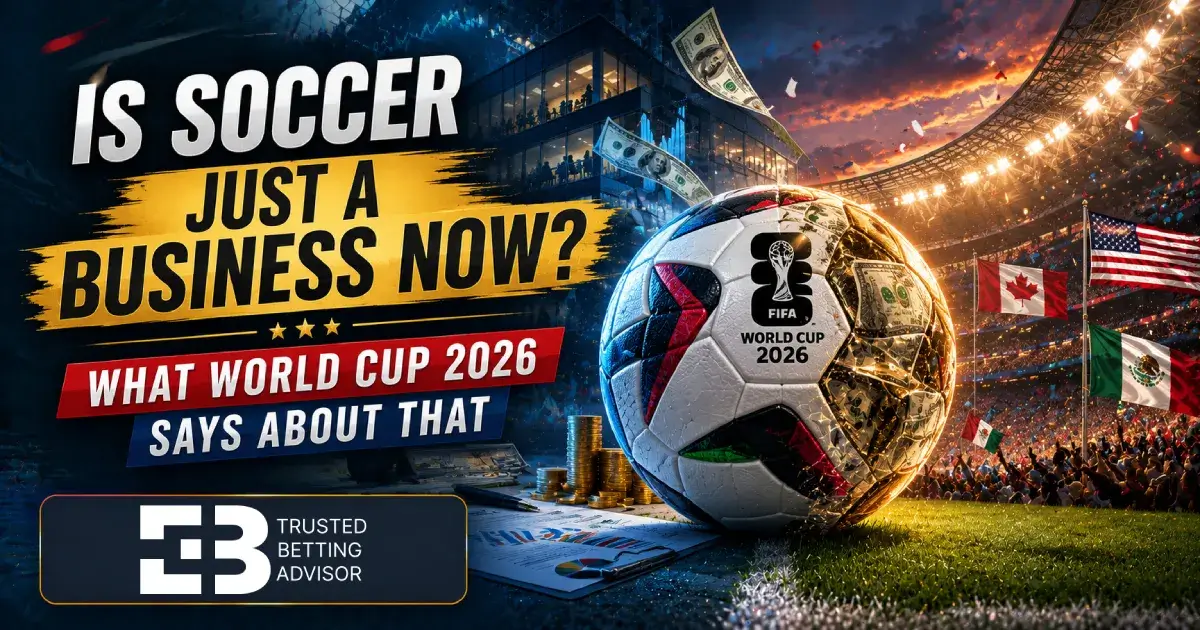
World Cup 2026 made that question even harder to avoid. The tournament is bigger than ever, with 48 teams participating and 104 matches all across North America. While it is a celebration of global soccer, it is also a massive product, built to attract more fans, more sponsors, tourism, and… money.
So perhaps the question is not if soccer is business now. It clearly is. However, the better question is whether the sport can exist within a business structure that decides how we, regular soccer fans, consume the game.
Soccer Always Had a Business Side
Soccer was never completely separate from money. Even before the modern era, clubs needed ticket sales, owners, sponsors and other types of commercial backing. Even in the 50s, radios were allowed to broadcast only the second half of the match to encourage people to buy more tickets. That’s what kept the attendance high, even in lower leagues.
So the idea that soccer was pure and then suddenly became commercial is not really accurate. The sport has always had a business side. What changed is the scale.
Today, business is not something around soccer – it is inside of it. Tournament formats, fixture calendars, TV broadcasts, and fan experiences are all designed with a global audience in mind.
What most people wouldn’t even think of is that this does not automatically mean a bad decision. Soccer needs money to grow. Investment is used to improve stadiums, training facilities, player development and generally the access for fans around the world.
The problem is to differentiate between which is a sports decision and which is just a business decision.
World Cup 2026 is The Perfect Case Study
The ongoing World Cup is the clearest example of mixing business and soccer in the new reality.
The expansion to 48 teams can be defended from a sporting point of view. More nations get a chance to participate, more fans see their country represented, and players from smaller leagues get the opportunity to play on the biggest stage possible.
That is something that should not be underestimated. A World Cup does not belong to any particular team or nation. Expanding it makes it feel global and more open.
But the expansion basically creates thousands more opportunities to make money. More teams, more matches, more tickets, more media coverage – the list is long. Every extra match is another chance to sell, promote and monetise.
But again, here is something most soccer fans miss. The arguments from the above – favouring either the sport or building a commercial intent can go together. A bigger World Cup may genuinely give more countries a chance to be in the spotlight. At the same time, it further builds the global entertainment business.
The Fans Are No Longer Just Fans
In a traditional sense, a soccer fan is there to watch and support the team. In modern times, the fan is also a consumer.
They may buy a ticket, a season pass, travel with the team, purchase a shirt, use statistics, play a fantasy game or consume team-related content.
This, of course, does not make the fans less genuine. They can do all of that and feel the same emotional connection with the team. Sometimes, fans feel even more connected when contributing to the team. Modern times have just reshaped and expanded the ways everyone can engage and support their favourite team.
In some ways, this is a positive thing. Purchasing team merch, watching their matches or to support them by consuming online content can be done from all over the world, which means you can stay connected and support them from all across the world.
But there is also a negative side. The fans are no longer just fans – they become the product. And this leads to fans being managed all the time. Every emotion is wrapped in content. Every tournament is shaped like something to sell. That’s what some of the dedicated fans are becoming hesitant – they still love the game, but they are also aware that the emotional connection is replaced with a whole money-printing machine.
Expanding Calendar Also Affects Players
The business side of soccer affects not only fans but also players. Most elite soccer players play on a pretty tight schedule. Domestic leagues, continental competitions and national teams leave very little room for rest.
The most painful evidence of the unforgiving corporate machine is Barcelona’s midfielder, Pedri. During the 2020/2021 season, at just 18 years of age, he played a total of 73 matches in a single season – from La Liga to the Champions League to Euro 2020, and later the Tokyo Olympics. The pressure for hjis body was immense – before that, Pedri never took time off because of injury. After that, he had 9 consecutive injuries, mostly to the hamstrings, totalling 70+ missed matches.
Player welfare has become one of the most important issues, but this seems to be discussed mostly after the calendar has already expanded. So, the game asks more of players and later seeks to manage the consequences through recovery plans and other adjustments.
Soccer is Still a Sport, But Now Business Shapes the Stage
Soccer is not dead. And it’s not only a corporation with strict rules. The game still belongs to the fans. Yes, modern soccer exists within a business structure that shapes everything around the game. It influences everything – from the schedule of the tournaments to player performances. However, soccer remains different from ordinary entertainment and has the power to surprise.
More Interesting Articles